Math Makes Sense 8 PDF: A Comprehensive Guide
Math Makes Sense 8, a Pearson publication, is a Grade 8 resource meticulously crafted to bolster essential mathematical abilities.
It delivers clarity through accessible explanations and relatable, practical examples, fostering a strong foundation for future learning.
What is Math Makes Sense 8?
Math Makes Sense 8 is a comprehensive mathematics textbook designed specifically for Grade 8 students, published by Pearson. It’s more than just a collection of problems; it’s a carefully structured program built to help students develop a deep and lasting understanding of core mathematical concepts. The textbook emphasizes building foundational skills through clear explanations, numerous examples, and real-world applications, making mathematics relatable and engaging.
This resource aims to prepare students for success in higher-level math courses by focusing on key areas like integers, rational numbers, linear equations, and the Pythagorean theorem. Interactive elements and a visually appealing layout further enhance the learning experience. The series, including Math Makes Sense 7 and 8, provides a progressive learning path, ensuring students are well-equipped to tackle increasingly complex mathematical challenges. It’s a tool designed to empower students and foster confidence in their mathematical abilities.
Overview of the Textbook
The Math Makes Sense 8 textbook spans approximately 560 pages and is organized into distinct units, each focusing on a specific area of mathematics. These units include explorations of square roots and the Pythagorean theorem, a deep dive into integers, rational numbers, and linear equations and inequalities. Each unit begins with an introductory section outlining “What You’ll Learn” and “Why It’s Important,” connecting concepts to real-world scenarios.
Throughout the textbook, key vocabulary is highlighted, and ample practice problems are provided, supported by readily available answer keys. Supplementary materials, like practice and homework books, and glossaries, further enhance the learning process. Digital resources and online tools complement the print edition, offering interactive exercises and additional support. The textbook’s structure promotes a logical progression of skills, building upon previously learned concepts.
Target Audience and Grade Level
Math Makes Sense 8 is specifically designed for students in Grade 8, typically aged 13-14, who are progressing through their middle school mathematics curriculum. The textbook caters to a diverse range of learners, aiming to solidify foundational math skills necessary for success in higher-level courses like Algebra. It’s intended for students who benefit from a clear, step-by-step approach to mathematical concepts.
The content is aligned with standard Grade 8 math curricula, covering essential topics required for academic advancement. It’s suitable for both students who are comfortable with mathematics and those who may require additional support and practice. The textbook’s interactive elements and real-world applications aim to engage students and make learning more accessible and relevant.
Key Features and Learning Approach
Math Makes Sense 8 employs a visually engaging and student-centered learning approach; Key features include “What You’ll Learn” sections to preview concepts and “Why It’s Important” to demonstrate real-world relevance. The textbook emphasizes a step-by-step problem-solving process, building confidence through guided practice.
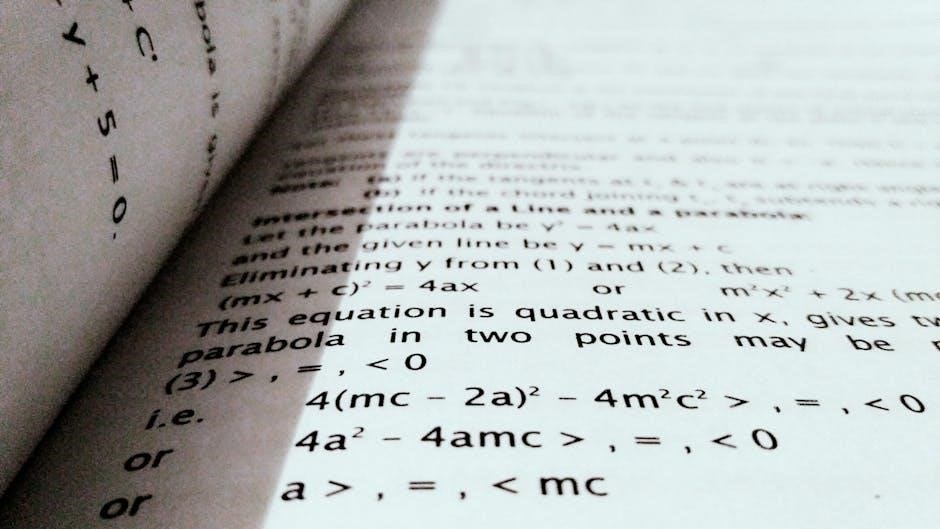
Interactive elements, like games and puzzles, are integrated to reinforce understanding. Each unit begins with an engaging opener, followed by clear explanations, worked examples, and ample practice exercises. A glossary of mathematical terms is included for quick reference. The textbook promotes active learning, encouraging students to explore concepts and apply their knowledge. It aims to build a strong foundation by connecting mathematical ideas to everyday situations.

Core Content Areas Covered
Math Makes Sense 8 comprehensively covers essential topics, including square roots, the Pythagorean theorem, integers, rational numbers, and linear equations, building crucial skills.
Unit 1: Square Roots and the Pythagorean Theorem
Unit 1 of Math Makes Sense 8 delves into the fascinating world of square roots and their practical applications, alongside the foundational Pythagorean Theorem. Students begin by exploring perfect squares and non-perfect squares, learning to estimate square roots and represent them accurately.
The unit then progresses to a detailed examination of the Pythagorean Theorem – a cornerstone of geometry – and its use in determining missing side lengths of right triangles. Students practice applying this theorem to solve real-world problems, fostering a deeper understanding of its relevance.
Throughout this unit, emphasis is placed on visualizing these concepts and developing problem-solving strategies. The textbook provides ample examples and practice exercises, including explorations of Pythagorean triples and their patterns, ensuring students build a solid grasp of these essential mathematical principles. Answer keys are available for self-assessment and reinforcement.
Unit 2: Integers
Unit 2 in Math Makes Sense 8 comprehensively covers the concept of integers, extending beyond positive whole numbers to include negative numbers and zero. Students learn to represent integers on a number line, understanding their magnitude and relative position.
The unit focuses on performing all four basic arithmetic operations – addition, subtraction, multiplication, and division – with integers. Emphasis is placed on understanding the rules for operating with positive and negative numbers, and applying these rules accurately.
Interactive activities and real-world examples, such as temperature scales and financial transactions, help students grasp the practical relevance of integers. The textbook includes exercises involving comparing and ordering integers, and solving equations involving integer operations. Students also explore the concept of opposites and absolute value, solidifying their understanding of this crucial mathematical foundation.
Unit 3: Rational Numbers
Unit 3 of Math Makes Sense 8 delves into the world of rational numbers, building upon the foundation of integers. Students explore numbers that can be expressed as a fraction, p/q, where q is not zero, encompassing fractions, decimals, and percentages.
The unit emphasizes converting between these different forms of rational numbers and comparing their values. Students learn to perform arithmetic operations – addition, subtraction, multiplication, and division – with fractions and decimals, mastering techniques like finding common denominators and decimal alignment.
Real-world applications, such as measuring ingredients in recipes or calculating discounts, are used to illustrate the relevance of rational numbers. Exercises focus on simplifying fractions, ordering rational numbers on a number line, and solving problems involving rational number operations, strengthening students’ numerical fluency.
Unit 4: Linear Equations and Inequalities
Unit 4 in Math Makes Sense 8 introduces the fundamental concepts of linear equations and inequalities, marking a crucial step towards algebraic thinking. Students learn to translate word problems into mathematical equations, utilizing variables to represent unknown quantities.
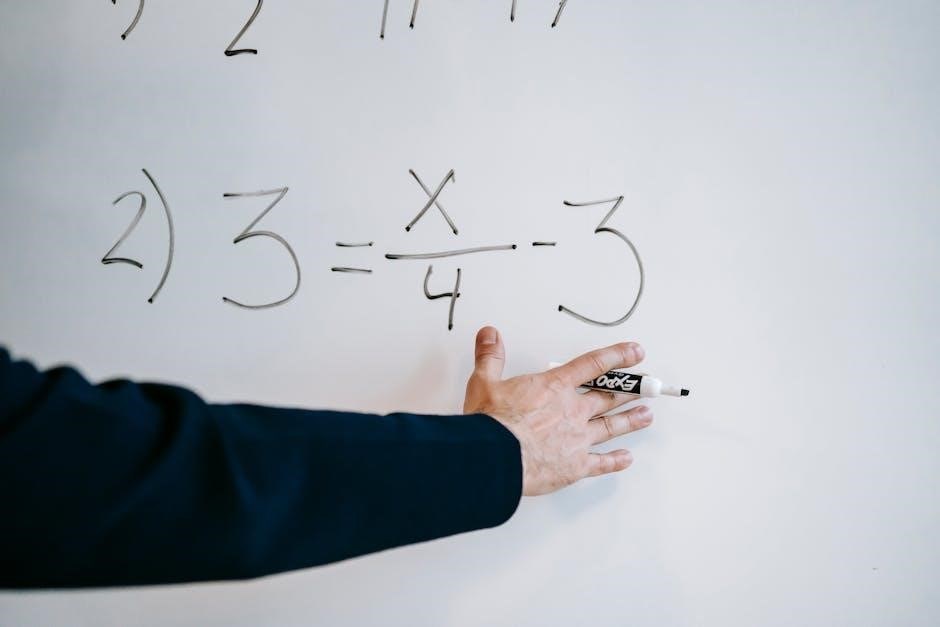
The unit focuses on solving one-step and two-step equations, employing inverse operations to isolate the variable. Students also explore inequalities, understanding the symbols (<, >, ≤, ≥) and how to represent solutions graphically on a number line.
Emphasis is placed on verifying solutions to both equations and inequalities. Practical applications, like determining costs or comparing quantities, demonstrate the relevance of these skills. Exercises involve modeling real-world scenarios with linear equations and inequalities, fostering problem-solving abilities and a deeper understanding of algebraic relationships.

Resources Available with Math Makes Sense 8
Math Makes Sense 8 provides comprehensive support, including answer keys, practice books, a glossary of terms, and valuable online digital tools for enhanced learning.
Answer Keys and Solutions
Math Makes Sense 8 offers readily available answer keys and detailed solutions, crucial for both students and educators. These resources facilitate self-assessment, allowing students to verify their understanding of concepts and identify areas needing further attention.
The answer keys cover all practice questions, homework assignments, and unit review exercises within the textbook. Detailed solutions demonstrate step-by-step problem-solving techniques, promoting a deeper comprehension of mathematical processes. Educators can efficiently assess student progress and provide targeted support.
Specifically, documents like “Math Makes Sense 8 ⎯ Answer Key.pdf” (as found on platforms like Langara College resources) provide comprehensive answers to unit questions, such as those in Unit 1 concerning Square Roots and the Pythagorean Theorem. Access to these solutions empowers independent learning and reinforces key mathematical skills.
Practice and Homework Books
Complementing the Math Makes Sense 8 textbook, dedicated practice and homework books are available to reinforce learning and build proficiency. These books provide a wealth of additional exercises, allowing students to apply concepts learned in class and solidify their understanding.
The practice questions are carefully aligned with the textbook content, offering varied difficulty levels to cater to diverse learning needs. Homework assignments are designed to be completed independently, fostering self-reliance and responsibility. A “Practice and Homework Book Gr 8” is readily available as a PDF download, containing extensive practice opportunities.
These supplementary materials are invaluable for students seeking extra practice or those requiring additional support. Consistent engagement with the practice and homework books significantly contributes to improved mathematical skills and overall academic success, enhancing comprehension of core concepts.
Glossary of Mathematical Terms
A comprehensive glossary of mathematical terms is an essential component of the Math Makes Sense 8 resources, designed to support student understanding of key vocabulary. This glossary provides clear and concise definitions for all the important terms introduced throughout the textbook, ensuring students can confidently navigate complex concepts.
The glossary serves as a valuable reference tool, enabling students to quickly look up unfamiliar terms and reinforce their comprehension. It’s readily available as a PDF document, easily accessible for both in-class and at-home study. Understanding mathematical terminology is crucial for success, and this glossary facilitates that process.
By providing definitions in a student-friendly manner, the glossary empowers learners to actively engage with the material and build a strong foundation in mathematical language, improving overall performance.
Online Resources and Digital Tools
Supplementing the Math Makes Sense 8 textbook, Pearson offers a suite of online resources and digital tools designed to enhance the learning experience. These resources aim to provide interactive practice, additional support, and opportunities for deeper understanding of mathematical concepts.
While specific details regarding the digital components may vary, generally, these resources include interactive tutorials, practice quizzes, and downloadable worksheets. Access to these tools often requires registration through Pearson’s online platform, providing students with a personalized learning environment.
These digital tools complement the PDF textbook, offering a dynamic and engaging way to reinforce skills and address individual learning needs. They are designed to be accessible on various devices, promoting flexibility and convenience for students.

Accessing the Math Makes Sense 8 PDF
Math Makes Sense 8 PDF access involves legal considerations; purchasing from official sources or authorized retailers ensures ethical and legitimate textbook acquisition.
Legal and Ethical Considerations
Accessing the Math Makes Sense 8 PDF requires careful attention to copyright laws and ethical practices. Downloading or distributing unauthorized copies constitutes a violation of intellectual property rights, potentially leading to legal repercussions. Pearson, the publisher, retains exclusive rights to the textbook’s content, and unauthorized reproduction infringes upon these rights.
Supporting the educational publishing industry by purchasing legitimate copies ensures the continued development of high-quality learning materials. Utilizing legally obtained PDFs safeguards the integrity of the educational process and respects the efforts of the authors and publishers. Seeking free, unofficial PDF versions often exposes users to potential security risks, including malware and viruses. Prioritizing ethical access demonstrates respect for intellectual property and contributes to a sustainable educational ecosystem.
Always verify the source’s legitimacy before downloading any PDF to avoid legal issues and protect your digital security.
Finding Free PDF Versions (Cautionary Note)
While the internet offers numerous sources claiming to provide free Math Makes Sense 8 PDF downloads, exercising extreme caution is crucial. Many of these sources are unreliable and may host illegally distributed materials, violating copyright laws. Downloading from such sites carries significant risks, including exposure to malware, viruses, and compromised personal information.
Furthermore, the quality of these free PDFs is often substandard, featuring missing pages, poor formatting, or incomplete content. These issues can hinder effective learning and create frustration. Legitimate educational resources require investment and support the authors and publishers who create them.
It’s strongly advised to avoid these questionable sources and opt for official, legal purchasing options to ensure a safe and reliable learning experience. Prioritize your digital security and respect intellectual property rights.
Purchasing Options and Official Sources

To acquire a legitimate copy of Math Makes Sense 8, several official sources are readily available. Pearson, the publisher, offers the textbook directly through their website, ensuring you receive a high-quality, authorized version. Major online booksellers, such as Amazon and Barnes & Noble, also stock the textbook in both physical and digital PDF formats.
Educational retailers and local bookstores are additional reliable options for purchasing Math Makes Sense 8. Consider exploring bundled packages that may include the textbook, practice and homework books, and access to online resources.
Purchasing from official sources guarantees access to complete, accurate content and supports the ongoing development of valuable educational materials. Verify the seller’s authenticity before completing any transaction to avoid counterfeit products.
Benefits of Using Math Makes Sense 8
Math Makes Sense 8 excels with clear explanations, real-world applications, and a focus on building foundational skills, engaging students effectively in mathematics.
Clear Explanations and Examples
Math Makes Sense 8 distinguishes itself through its commitment to presenting mathematical concepts in an exceptionally clear and understandable manner. The textbook avoids overly complex jargon, instead opting for language that resonates with Grade 8 students. Each topic is broken down into manageable steps, ensuring a gradual and logical progression of learning.
Furthermore, the textbook doesn’t simply state rules; it actively demonstrates them through a wealth of worked examples. These examples aren’t just abstract calculations; they are carefully chosen to illustrate the practical application of each concept. Students are guided through each step of the problem-solving process, fostering a deeper understanding of the underlying principles. The inclusion of diverse example problems caters to different learning styles and helps students build confidence in their abilities. This approach ensures that students aren’t just memorizing formulas, but truly grasping the ‘why’ behind the math.
Real-World Applications
Math Makes Sense 8 doesn’t confine mathematics to the abstract realm of numbers and equations; it actively bridges the gap between classroom learning and everyday life. A key strength of the textbook lies in its consistent emphasis on real-world applications of mathematical concepts. Problems are presented within relatable contexts, demonstrating how math is used in fields like architecture, engineering, finance, and even everyday activities like shopping or cooking.
This approach isn’t merely about making math more engaging; it’s about fostering a deeper understanding of its relevance. By seeing how mathematical principles are applied in practical situations, students are better able to appreciate their value and retain the information. The textbook incorporates scenarios that students can easily connect with, making the learning process more meaningful and motivating. This connection solidifies understanding and prepares students for future challenges.
Building Foundational Math Skills
Math Makes Sense 8 is strategically designed to construct a robust foundation in mathematics, preparing students for success in higher-level courses. The textbook systematically builds upon previously learned concepts, ensuring a smooth progression of skills. It doesn’t assume prior knowledge, instead, it reinforces fundamentals while introducing new ideas in a logical sequence.
The curriculum focuses on core areas like integers, rational numbers, linear equations, and the Pythagorean theorem, providing ample practice opportunities to solidify understanding. Through clear explanations, worked examples, and varied exercises, students develop proficiency in essential mathematical techniques. This methodical approach fosters confidence and competence, empowering students to tackle more complex problems with ease and setting them up for continued academic achievement.
